
Sake, Through Time and Place · Special feature · Sources checked: 16 October 2026
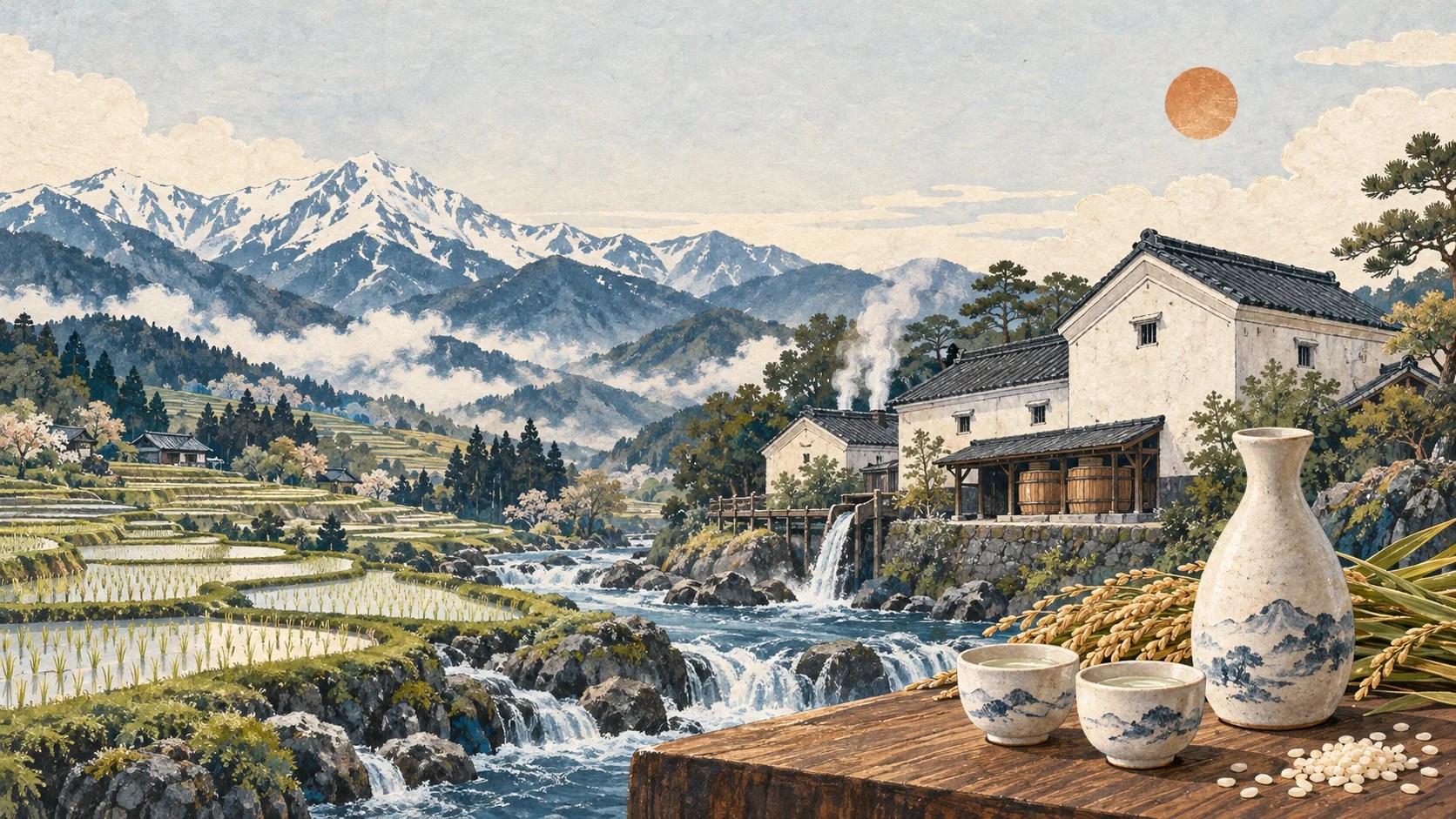
Why does Niigata so often suggest a clean, light style, while Saga evokes fuller rice savouriness? Both begin with rice and water. Their differences emerge through ingredients, microorganisms and the decisions of the people who brew.
Hiroshima offers a revealing example. During the Meiji period, Senzaburo Miura (三浦仙三郎) worked with soft water then considered difficult for reliable brewing. Rather than abandoning the local resource, he developed a method adapted to it. Regional character grew through that practical response. [10]
Understanding how rice becomes sake gives the place names on a label a richer meaning. Here are eight starting points.
Two microorganisms turn rice into sake
Preparing the rice
Rice is polished, washed, soaked and steamed. A rice-polishing ratio (精米歩合) of 60% means that 60% of the original brown-rice weight remains: 100 kilograms becomes 60 kilograms of polished rice. The number describes processing; it cannot rank deliciousness on its own. [2] [3]
Making sugar while fermenting it
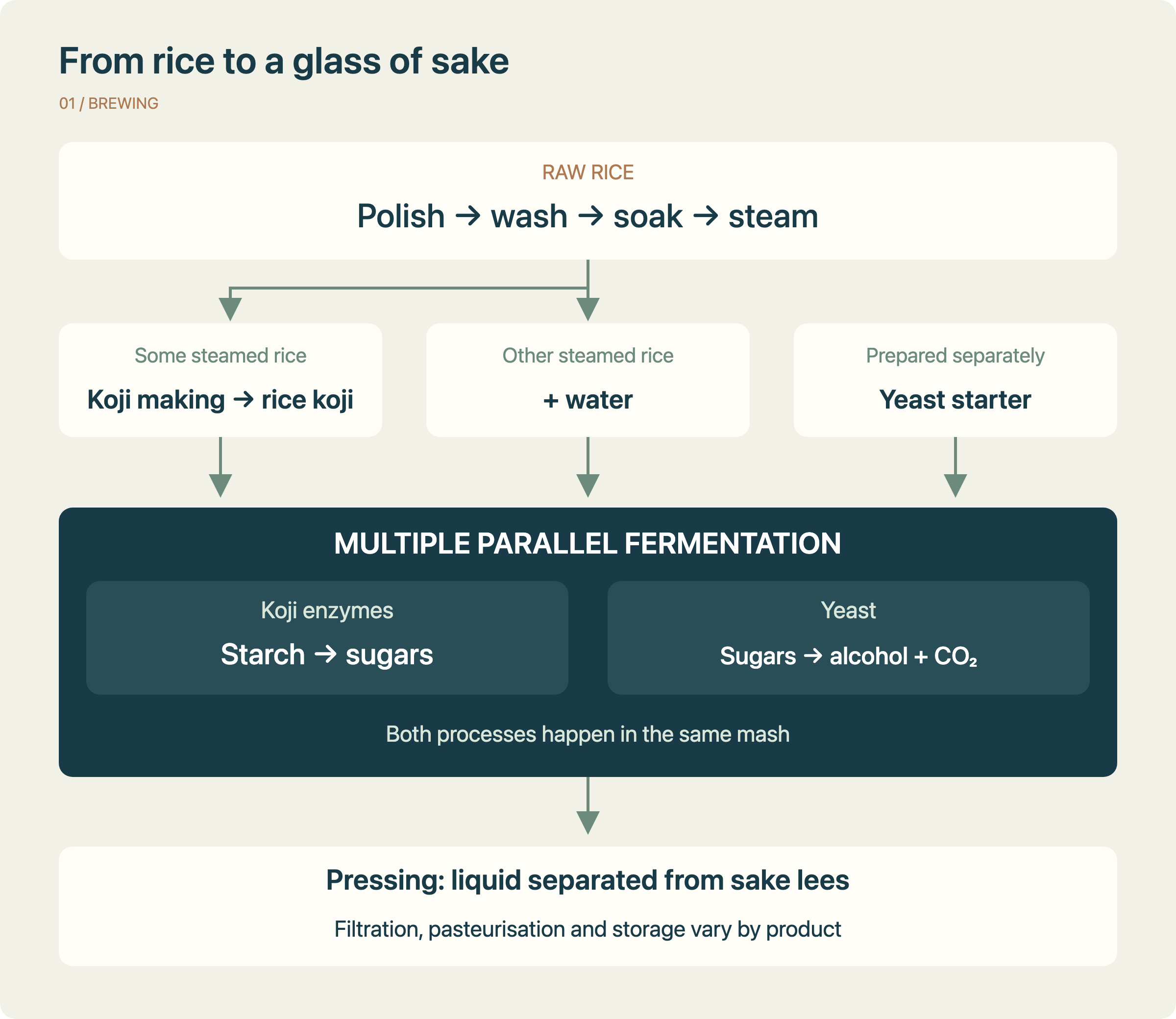
Rice contains starch, which yeast cannot directly turn into alcohol. Koji mould grows on a portion of steamed rice to make rice koji (米麹). Its enzymes release sugars, while yeast converts sugar into alcohol and carbon dioxide. These processes overlap in the same main mash: multiple parallel fermentation (並行複発酵). [1] [2]
Building fermentation gradually
The yeast starter (酒母) establishes a yeast population. In a typical three-stage addition (三段仕込み), koji, steamed rice and water are added on days one, three and four; day two is a rest called odori (踊り). Three additions therefore span four days, helping prevent excessive yeast dilution and manage fermentation. [1]
Shaping the sake after pressing
Pressing separates liquid from sake lees (酒粕). Subsequent filtration, pasteurisation, storage and adjustments depend on the product. Pasteurisation (火入れ) helps control microorganisms and enzyme activity; unpasteurised sake, namazake (生酒), has never undergone it. These decisions also shape a bottle’s expression. [2] [3]
Eight places, eight ways into sake
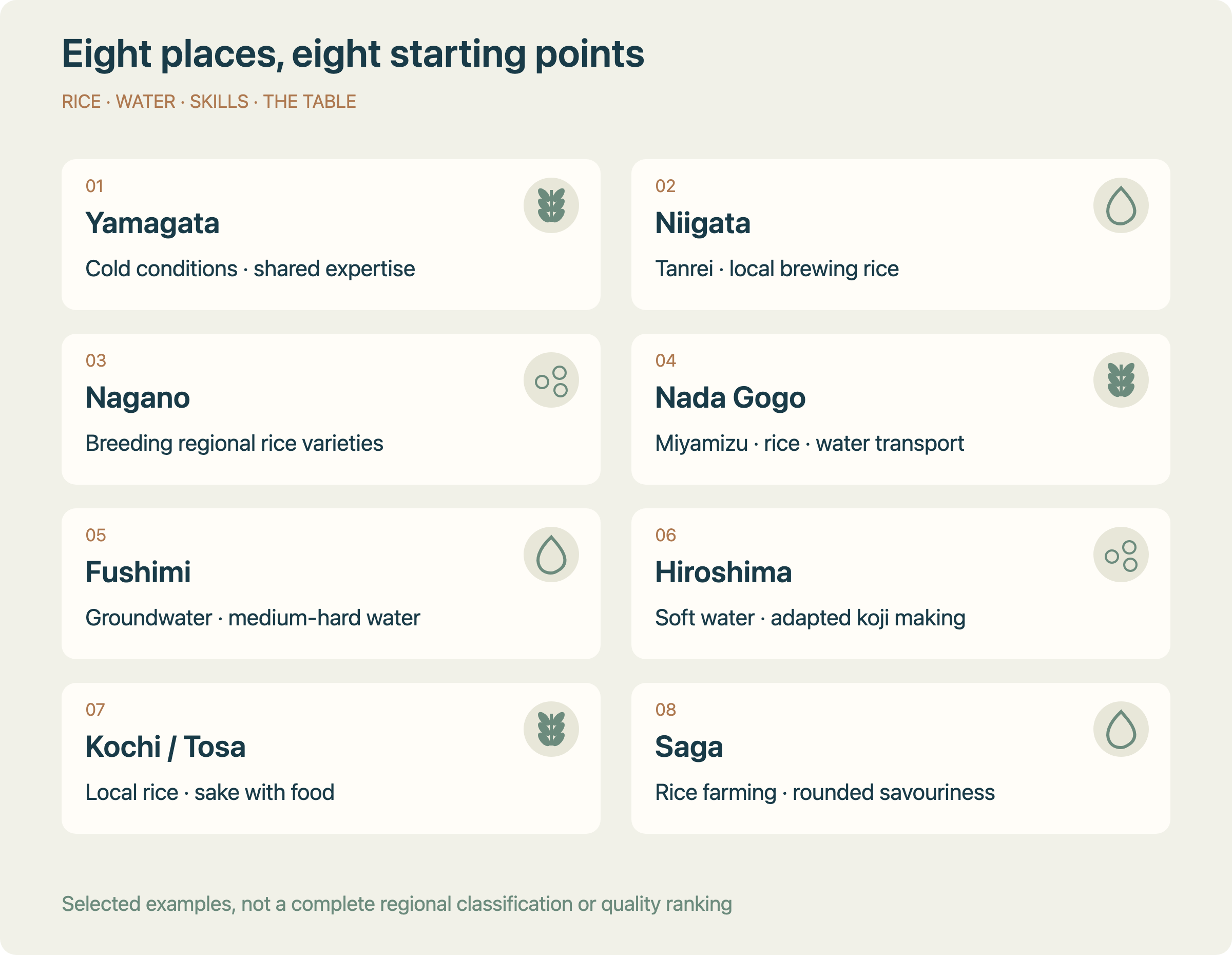
This selection compares prefectures and historic brewing districts. It is neither a complete list nor a quality ranking. Regional descriptions draw on official bodies and brewers’ associations; individual breweries and products vary.
Yamagata | Cold weather meets shared learning
The National Tax Agency describes Yamagata sake as generally soft and clear, highlighting harmony between texture and fruit-like aromas in ginjo styles. Cold winters and soft water provide conditions; training and exchanges among breweries and local researchers turn those conditions into expertise. Shared learning belongs in its regional story. [4]
Niigata | More than a light, clean reputation
Tanrei (淡麗) suggests lightness and a clean finish; karakuchi (辛口) means a dry impression, rather than chilli heat. Soft water, winter conditions and rice such as Gohyakumangoku (五百万石) and Koshi Tanrei (越淡麗) help explain the reputation. The local association also introduces fruity and richer styles. Tanrei opens the conversation; it does not close it. [5] [6]
Nagano | Regional character keeps growing
Start with rice names: Miyamanishiki (美山錦), Hitogokochi (ひとごこち) and Sankeinishiki (山恵錦) appear in the association’s account of local breeding. They show that regional identity includes agricultural research and changing production choices. Note the rice, then check polishing, yeast and method; a variety alone cannot predict a finished sake. [7]
Nada Gogo, Hyogo | Water, rice and a route to market
The Nada Gogo (灘五郷) association links local development to Yamadanishiki (山田錦), mineral-rich Miyamizu (宮水), cold Rokko winds and water transport. Agriculture, brewing conditions and distribution form one story. For a particular bottle, ask how its brewery uses these resources and which choices make its own expression distinctive. [8]
Fushimi, Kyoto | Mellow sake needs a precise water story
Fushimi’s groundwater passes through the Momoyama hills. Its brewers’ association describes representative brewing water as medium-hard, with a balance of minerals including potassium and calcium, and associates local sake with a fine, mellow character. A soft-feeling palate should not automatically be explained as the result of soft water. [9]
Hiroshima | Adapting koji making to soft water
Miura’s soft-water method illustrates a brewer’s response to local conditions. Regional material describes allowing koji to penetrate deeply into rice, supporting saccharification and subsequent fermentation. It brings us back to the shared mash: the water presents conditions, while brewers adjust how koji and yeast work within them. [10] [11]
Kochi, Tosa | A sake story at the table
The Kochi association introduces Tosa sake through clear acidity, relatively few distracting flavours and a crisp, dry finish, emphasising its role with food. Local rice development includes Gin no Yume (吟の夢) and Tosaurara (土佐麗). Ingredients and dining offer complementary ways to explore how a sake unfolds and finishes. [12] [13]
Saga | Keeping rice richness in the glass
Saga’s association and GI introduction highlight rounded texture, rice sweetness and generous savouriness. Rice farming on the Saga plain and mountain water provide a foundation; brewing expertise develops the expression. This rich, umami-led direction offers one perspective on Kyushu sake, while leaving room for the diversity of individual Saga products. [14] [15]
Three questions for your next sake label
First, distinguish where the sake was brewed from where its rice was grown: a brewery address does not establish the rice’s origin. Next, look for information about rice, yeast, starter, pasteurisation or storage, and the style the producer wants to express. Finally, bring those details back to your own table.
For a small comparison, choose two bottles whose producers describe their aims as clean and light, or full and rich. Note sweetness, acidity, savouriness and finish, then try a familiar dish and observe the change. This is a suggested reading and tasting exercise, not a test conducted by the author; there is no need to open bottles from all eight places.
Sake’s regional character includes mountains and water, but also rice breeding, koji making, shared expertise and food. A little knowledge of brewing helps a place name prompt a better question—and makes each bottle more interesting to read.
Sources and further reading
- JSS | Sake brewing processes
- NRIB | What is Sake?
- NRIB | Sake Q&A
- National Tax Agency | GI Yamagata: Seishu / Sake
- National Tax Agency | GI Niigata product specification
- Niigata Sake Brewers Association | The secret of deliciousness
- Nagano Sake Brewers Association | Rice, yeast and water
- Nada Gogo Brewers Association | The brewing region of Nada Gogo
- Fushimi Sake Brewers Association | The water of Fushimi
- Hiroshima Prefecture Sake Brewers Association | History
- The Great Sakes of Hiroshima | Characteristics
- Kochi Sake Brewers Association | TOSA NAKAMA
- Kochi Sake Brewers Association | Rice and brewing materials
- Saga Sake Brewers Association | GI Saga
- JSS | GI Saga
- JSS | Geographical indications for sake
Follow the legal drinking age where you live; in Japan it is 20. Enjoy in moderation.


Leave a Reply