
SAKE, THROUGH TIME AND PLACE · KYOTO
A glass of Kyoto sake can lead to a canal, a city workshop, a northern fishing town or the shores of Lake Biwa. Follow the makers and the choices behind the label.
By Kindness & Honesty · Sources checked: 21 October 2026
Where should you start with sake in Kyoto?
Start in Fushimi, in southern Kyoto City, for Gekkeikan, Kizakura, Tsukino Katsura and Sawaya Matsumoto. Look within the city for Jurakudai and Kagura, then further north in Kyoto Prefecture for Tamagawa and Ine Mankai. Across the prefectural boundary, Naminooto is brewed in Otsu, Shiga. Together, these nine producers connect local history with choices about rice, fermentation and time.
Geography · Water & rice · Production · Nine breweries · GI Kyoto · FAQ
First, separate Kyoto City from Kyoto Prefecture
“Kyoto sake” covers a much wider landscape than the streets around Kyoto Station. The northern coast belongs to Kyoto Prefecture, but deserves a separate journey. Nearby Shiga is a different prefecture altogether.
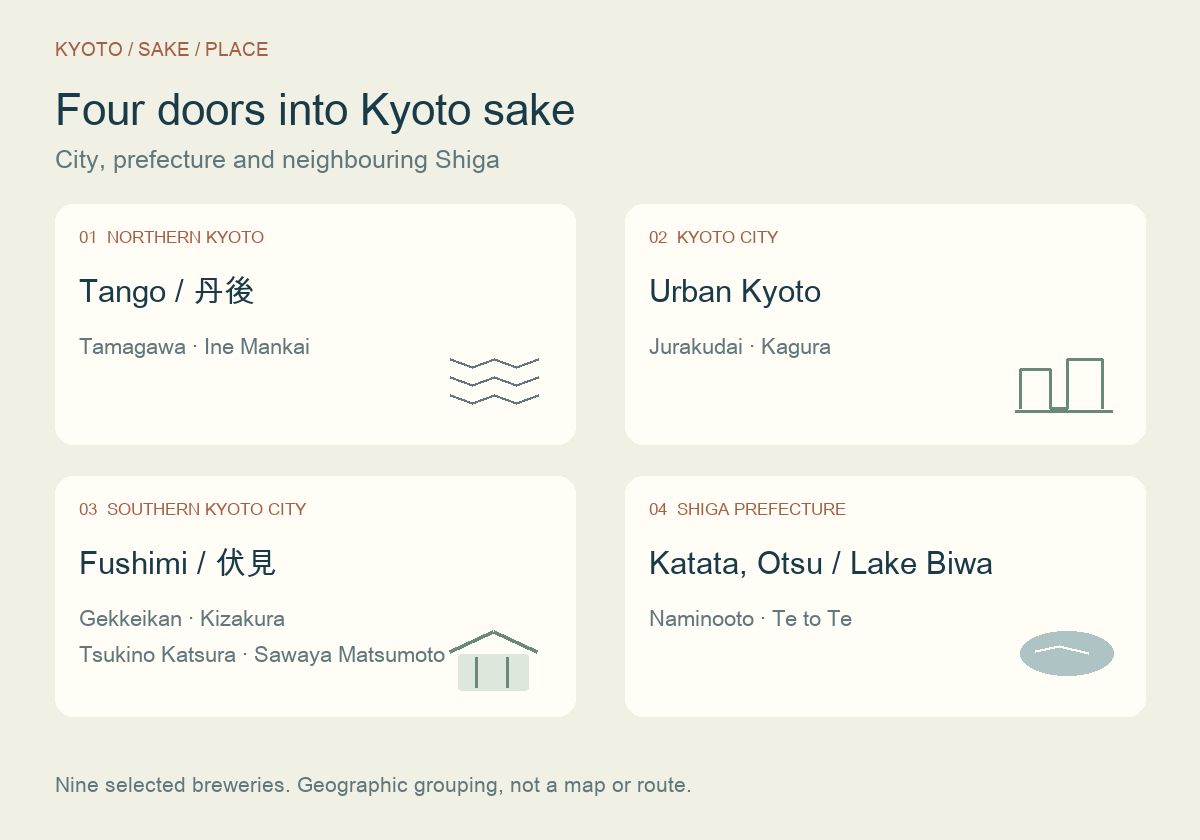
| Area | Geographical scope | Breweries in this guide |
|---|---|---|
| Fushimi / 伏見 | Southern Kyoto City | Gekkeikan; Kizakura; Masuda Tokubee Shoten; Matsumoto Shuzo |
| Urban Kyoto / 洛中・鴨川周辺 | Kamigyo and Sakyo wards, Kyoto City | Sasaki Shuzo; Matsui Shuzo |
| Tango / 丹後 | Northern Kyoto Prefecture: Kumihama and Ine | Kinoshita Brewery; Mukai Brewery |
| Katata, Otsu / 大津・堅田 | Shiga Prefecture, beside Lake Biwa | Naminooto Shuzo |
Fushimi: the water beneath the canal town
Fushimi’s canals are an inviting introduction, but the brewing story runs underground. The local brewing organisation Fushimi Joyukai describes the groundwater as medium-hard, very low in iron, with calcium and potassium. Calling all Fushimi brewing water simply “soft” loses a useful distinction. The organisation also records groundwater surveys and conservation work: protecting a water source is part of sustaining a brewing district. [3]
Water also moved people and goods. Gekkeikan’s historical account connects the growth of Fushimi brewing with castle-town demand and its role as a land and river transport hub. A cluster of breweries needs customers and routes to market as well as suitable water. [6]
Iwai rice: a local story with an interrupted history
Iwai (祝) is a Kyoto-developed sake rice. The Fushimi Sake Brewers Association traces its development to 1933 at the Tango branch of the prefectural agricultural experiment station. After cultivation disappeared, trial growing resumed in 1988; sake made from the revived rice reached the market in 1992. A label naming Iwai offers a connection to local agriculture, but check the actual rice-origin statement on the bottle. [4]
Brewing location and rice origin are separate facts. Matsumoto Shuzo’s Shuhari Gohyakumangoku, for example, is a Fushimi sake whose official product page specifies rice grown in Nanto, Toyama. That relationship between local water and rice from elsewhere is part of the story too. [13]
How production choices become differences in the glass
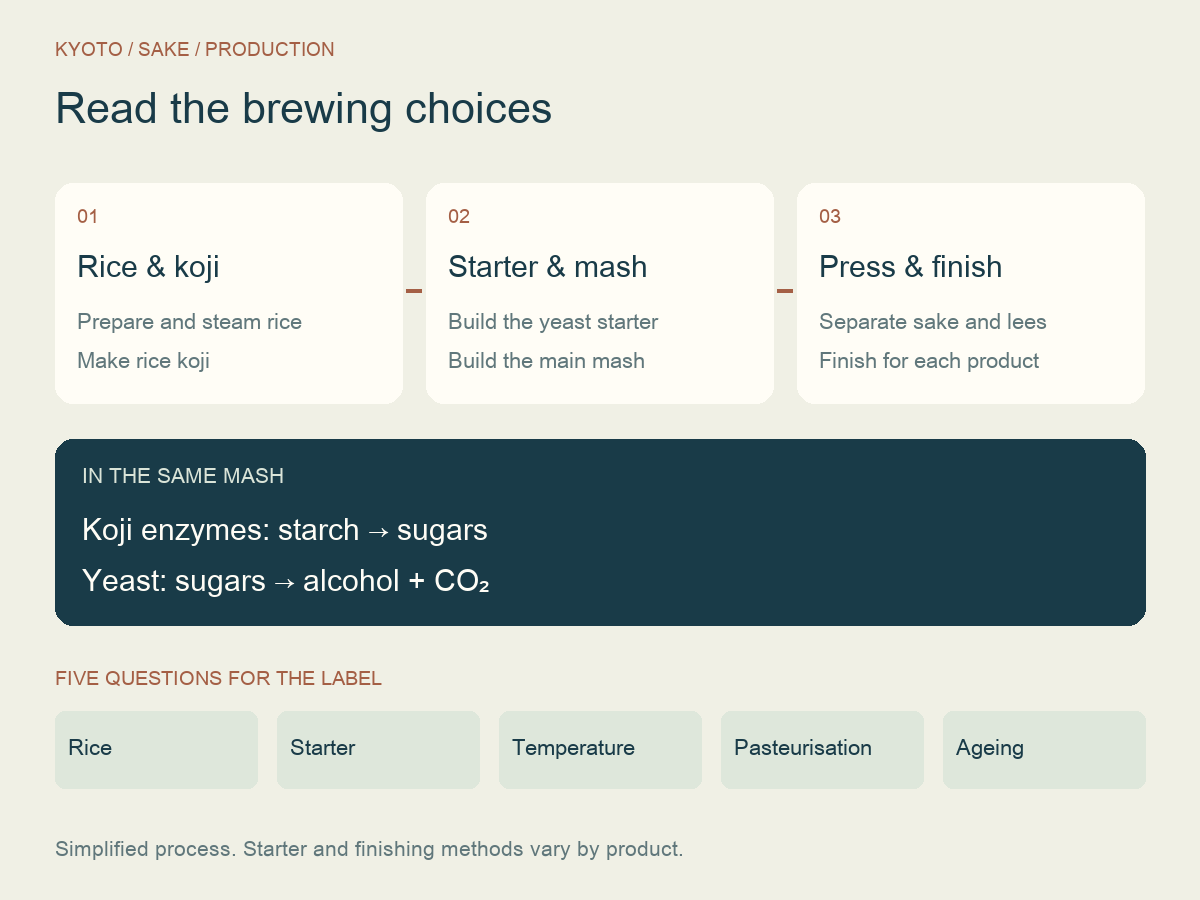
Kyoto brewers share sake’s core process: prepare and steam rice, make rice koji, develop a yeast starter, build the main mash, ferment, then press. In the mash, koji enzymes turn starch into sugars while yeast turns sugars into alcohol. These processes overlap; sake is brewed through multiple parallel fermentation. [5]
Brewers can change the expression through rice selection, koji work, starter management, fermentation temperature, pressing and finishing. Later choices include pasteurisation, dilution and ageing; their use depends on the product. A brand name alone does not describe all these decisions. Read the full bottle name and its production terms. [5] [17]
Kyoto’s production heritage includes technical change. The National Tax Agency’s account describes early adoption of year-round brewing. Within the same wider region, Matsui emphasises manual work throughout production, while Naminooto describes small-batch family brewing. Scale is a useful question to ask; it is not a substitute for understanding a particular sake. [1] [16] [20]
Nine breweries and sake names worth recognising
Use the Japanese names to match a shelf label or an official product page. A brand may include several rice varieties, grades and seasonal releases; the examples below identify starting points, not current stock.
| Brewery and place | Brand or bottle to look up | What makes it useful to compare |
|---|---|---|
| Gekkeikan / 月桂冠 Fushimi, Kyoto City | Horin Junmai Daiginjo / 鳳麟 純米大吟醸 | A named premium product from a historic Fushimi producer; pair the bottle research with the Okura Sake Museum. [7] [8] |
| Kizakura / 黄桜 Fushimi, Kyoto City | Fushimi no Kiippon Junmai Ginjo / 伏見の生一本 純米吟醸 | A specific sake to distinguish from Kizakura’s beer range; Fushimigura provides a production-oriented visitor setting. [9] [10] |
| Masuda Tokubee Shoten / 増田德兵衞商店 Fushimi, Kyoto City | Tsukino Katsura / 月の桂 | Sparkling nigori and long-aged sake show two different uses of texture and time within one brewery’s history. [11] |
| Matsumoto Shuzo / 松本酒造 Fushimi, Kyoto City | Sawaya Matsumoto Shuhari Gohyakumangoku / 澤屋まつもと 守破離 五百万石 | The official page specifies Toyama-grown rice and describes gentle natural fizziness and acidity. [12] [13] |
| Sasaki Shuzo / 佐々木酒造 Kamigyo, Kyoto City | Jurakudai Junmai Ginjo / 聚楽第 純米吟醸 | An urban Kyoto brewery near the former Jurakudai site, with several distinct product families. [14] [15] |
| Matsui Shuzo / 松井酒造 Sakyo, Kyoto City | Kagura / 神蔵 | Look up the precise Kagura edition: its range includes unfiltered, undiluted, unpasteurised sake. [16] |
| Kinoshita Brewery / 木下酒造 Kumihama, Kyotango, Kyoto Prefecture | Tamagawa / 玉川 | Spontaneous-fermentation products and ageing offer questions beyond aroma alone. [17] [18] |
| Mukai Brewery / 向井酒造 Ine, Kyoto Prefecture | Ine Mankai / 伊根満開 | The local tourism association identifies red rice, Murasaki Komachi, as a feature of this red sake. [19] |
| Naminooto Shuzo / 浪乃音酒造 Katata, Otsu, Shiga Prefecture | Naminooto / 浪乃音; Te to Te / てとて | A Lake Biwa-side comparison outside Kyoto; regular Te to Te products use Shiga-grown rice. [20] [21] |
Flavour descriptions above are attributed to producer or local official sources. This article reports research, not personal tasting, a sales ranking or a claim that every listed bottle carries GI Kyoto.
Four ways to explore the breweries
1. Fushimi: history, modern production and deliberate reinvention
Gekkeikan, founded in 1637, offers a historical doorway through its Okura Sake Museum. Kizakura’s Fushimigura makes a different connection between a familiar brand and a visitor-facing production facility; its official site asks visitors to reserve, including for a visit without a meal. A museum and a working brewery visit are different experiences, so check what the current booking includes. [6] [7] [9]
Then compare two more specific ideas. Masuda Tokubee Shoten dates its sparkling nigori development to 1964 and the start of long-aged junmai daiginjo storage to 1965. Tsukino Katsura therefore opens a conversation about texture and time. Matsumoto’s approach puts rice and food at the centre; the Shuhari Gohyakumangoku page supplies an unusually useful fact to check: Toyama rice brewed in Fushimi. [11] [12] [13]
2. Urban Kyoto: brewing continues within the city
Sasaki Shuzo was established in 1893 in Kamigyo. Its Jurakudai name connects the brewery to the former palace site; the account linking its Ginmeisui water to tea master Sen no Rikyu is presented as a local tradition in the prefecture’s interview. Keep that historical association distinct from a measurable water specification. [14]
Matsui Shuzo, founded in 1726, brews at its Kamogawa brewery in Sakyo. The company describes a small team and handwork from steaming through bottling. Kagura’s various editions make a practical label-reading exercise: compare the exact rice and production terms rather than treating all Kagura as one product. [16]
3. Northern Kyoto: the coast expands the picture
Kinoshita Brewery has brewed Tamagawa in Kumihama since 1842. Its official account highlights a spontaneous-fermentation range made without pure yeast cultures, along with ageing and changes in serving temperature. These are particular producer choices, not a definition of all Tango sake. [17]
In Ine, Mukai Brewery offers a different route into rice character. The Ine Tourism Association describes Ine Mankai as a red sake made with Murasaki Komachi red rice. Its colour provides a concrete question to ask about ingredients. Kumihama and Ine belong to the northern coastal part of Kyoto Prefecture; neither is a central Kyoto neighbourhood. [18] [19]
4. Nearby Shiga: a useful comparison across the boundary
Naminooto Shuzo is in Katata, Otsu, beside Lake Biwa. Founded in 1805, it describes small-batch family production. Its Te to Te range connects a newer generation’s approach with the brewery’s existing techniques and uses Shiga rice in its regular products. Compare that stated origin with the rice used in a Kyoto bottle. The exercise is about tracing choices, not deciding which prefecture makes “better” sake. [20] [21]
What does GI Kyoto actually tell you?
Kyoto was designated a sake geographical indication in October 2025, covering Kyoto Prefecture. The specification requires Japanese-grown rice, water collected in Kyoto Prefecture, and brewing, storage and bottling within the prefecture, alongside other conditions and verification. It does not require all rice to be Kyoto-grown. [2]
Check for the GI on the individual product; a Kyoto brewery address does not establish certification. Naminooto’s Shiga location is outside the Kyoto GI area. GI identifies a protected origin and production standard, rather than a league table of famous bottles. [1] [20]
Turn the research into a visit or a bottle comparison
Choose a geographical focus before choosing a list of stops. Fushimi is a natural starting point for the canal-town story and established visitor facilities. Sasaki and Matsui offer two city-based brewery identities to research. Treat Tango and Ine as a separate northern excursion, and Katata as a Shiga outing. These are editorial suggestions, not a timed or tested itinerary.
Before travelling, check the official venue page for bookings, opening days and the parts of production that can actually be seen. Kizakura notes that some facilities may not be operating during a visit. A shop being open does not establish access to the fermentation floor. [9]
At the table, begin with two bottles and one question: different rice origins, a pasteurised and an unpasteurised edition, or a fresh and an aged release. Record the exact product, temperature and food. For a nigori or unpasteurised bottle, follow its own storage and opening instructions. The comparison becomes more useful when the conditions are clear.
Kyoto sake: frequently asked questions
Which sake breweries are in Fushimi?
This guide covers Gekkeikan, Kizakura, Masuda Tokubee Shoten (Tsukino Katsura) and Matsumoto Shuzo (Sawaya Matsumoto). Fushimi is in Kyoto City. These four are a selection, not a complete brewery count. [6] [9] [11] [12]
Is all Kyoto sake made with soft water?
No single description fits every source. Fushimi Joyukai describes its district’s groundwater as medium-hard; Matsui describes very soft groundwater at its city brewery. Check the producer and water source. [3] [16]
What is Iwai rice?
Iwai (祝) is a Kyoto-developed sake rice first developed in 1933. Trial cultivation resumed in 1988, and sake from the revived rice was commercialised in 1992. [4]
Is Ine Mankai a Kyoto sake?
Yes. Mukai Brewery is in Ine, Kyoto Prefecture, on the northern coast. It is geographically separate from Kyoto City. Ine Mankai is known for its use of red rice. [19]
Is Naminooto brewed in Kyoto?
No. Naminooto Shuzo is in Katata, Otsu City, Shiga Prefecture. It is included as a nearby comparison around Lake Biwa. [20]
Does GI Kyoto mean every rice grain was grown in Kyoto?
No. The Kyoto GI specification requires Japanese-grown rice; the water and the specified production stages must be in Kyoto Prefecture. Other conditions and verification also apply. [1]
The most revealing Kyoto sake question is often a small one: where did this rice grow, which water was used, and what did the brewer choose to do next? Follow those answers and familiar names become places, people and production decisions you can actually recognise.
Sources and further reading
- National Tax Agency | GI Kyoto product specification
- National Tax Agency | GI Kyoto guide
- Fushimi Joyukai | Protecting water
- Fushimi Sake Brewers Association | Iwai rice
- Japan Sake and Shochu Makers Association | Brewing processes
- Gekkeikan | Fushimi Momoyama: history, water and sake
- Gekkeikan | Okura Sake Museum
- Gekkeikan | Horin Junmai Daiginjo
- Kizakura | Fushimigura
- Kizakura official shop | Fushimi no Kiippon Junmai Ginjo
- Masuda Tokubee Shoten | History
- Matsumoto Shuzo | Brewing philosophy and brands
- Matsumoto Shuzo | Shuhari Gohyakumangoku 720ml
- Kyoto Prefecture | Sasaki Shuzo interview
- Sasaki Shuzo | Product list
- Matsui Shuzo | Brewery and products
- Kinoshita Brewery | About Tamagawa
- Kinoshita Brewery | English home
- Ine Tourism Association | Mukai Brewery
- Naminooto Shuzo | About us
- Naminooto Shuzo | Te to Te
Research scope: nine selected breweries, not an exhaustive directory. Sources were reviewed on 21 October 2026. Product examples do not establish availability, tour access or GI certification. No first-hand brewery visits or tastings were conducted for this article.


Leave a Reply