
SAKE, THROUGH TIME AND PLACE · PART 01
Sake, Through Time and Place
Start with 100 kilos of rice. Polish it until only 23 kilos remain. Then use that rice to brew sake (日本酒).
That is what the number in Dassai’s Migaki Niwari Sanbu (磨き二割三分) describes: the proportion of rice weight left after polishing. For the strength of the drink, look elsewhere on the label, at its alcohol content. Dassai’s product information
But why 23 rather than 25?
According to the brewery’s account, the original target was 25%. Learning that another producer already offered 24% prompted a change to 23%. Those final two percentage points took another 24 hours of polishing. The brewery’s development story
More time, to leave less rice. What is the brewer trying to achieve? This bottle gives us a way into sake’s unfamiliar vocabulary—and a reason to want to understand it.
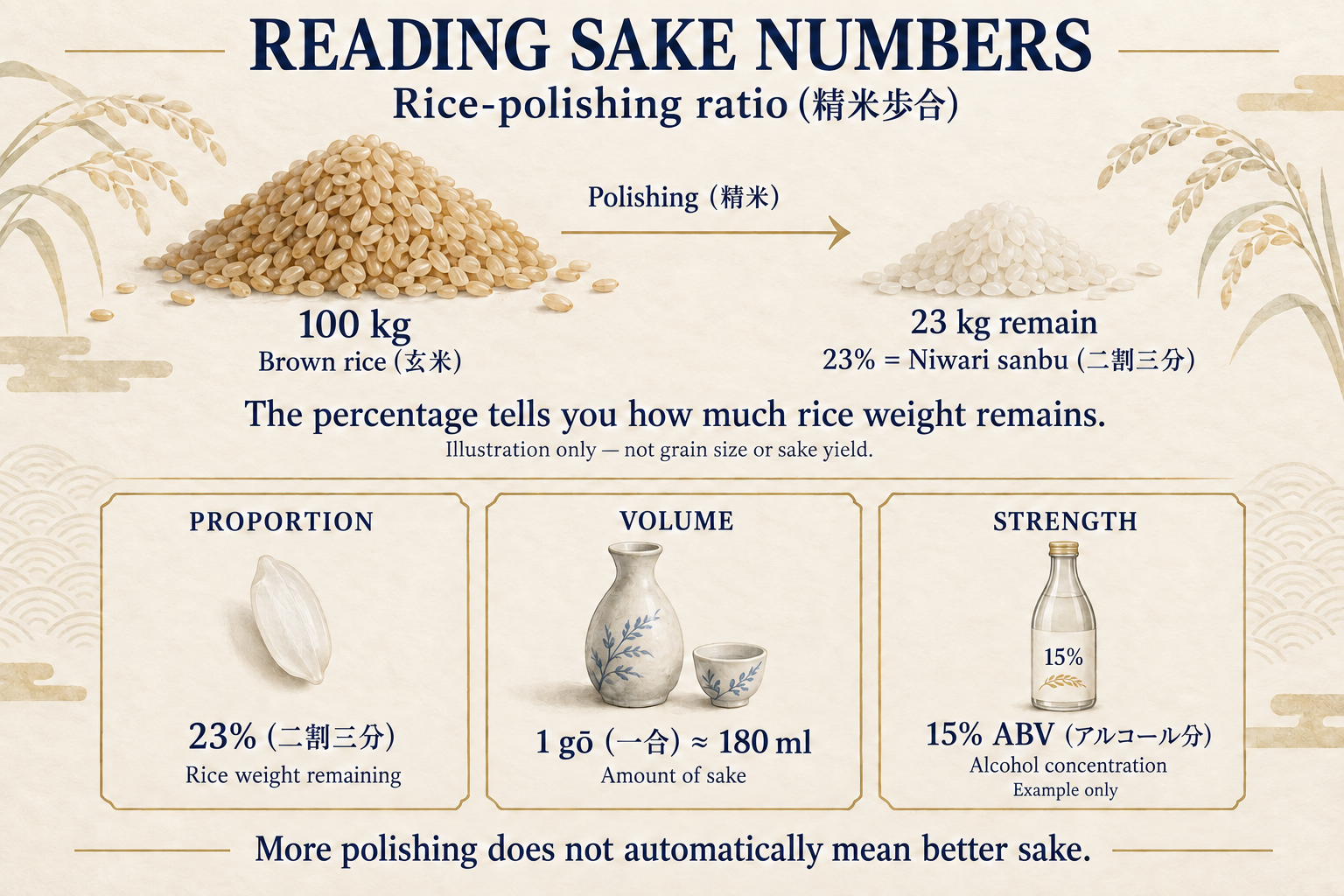
Reading sake numbers: the rice-polishing ratio (精米歩合) measures the rice weight remaining; gō (合) measures volume; alcohol content (アルコール分) measures strength. The 15% ABV bottle is an illustrative example.
The number tells you what remains
In Japanese, wari (割) means ten percentage points and bu (分) means one. Niwari sanbu (二割三分) therefore means 23%.
The technical term is rice-polishing ratio (精米歩合, seimai-buai): the weight of the polished white rice as a percentage of the original brown rice’s weight. Starting with 100 kilos makes the arithmetic clear:
| Polishing ratio | White rice remaining | Weight removed |
|---|---|---|
| 70% | 70 kilos | 30 kilos |
| 50% | 50 kilos | 50 kilos |
| 23% | 23 kilos | 77 kilos |
These are rice weights, not a calculation of how many bottles the batch will produce. The useful rule is simple: a smaller number means more polishing. The National Tax Agency’s explanation
Does more polishing mean better sake?
The outer layers of rice contain relatively more protein and fat, which can affect fermentation, aroma and flavour. Polishing helps a brewer adjust those components. But proteins can also contribute to flavours including umami (旨味); they are not simply unwanted material. National Research Institute of Brewing: rice polishing
A polishing ratio is not a score for deliciousness. Someone looking for a light, aromatic drink may want something different from someone seeking a fuller flavour with dinner. Yeast and fermentation choices matter too. One number cannot tell you the whole character of a sake—or whether you will enjoy it. Japan Sake and Shochu Makers Association: brewing and flavour
Rice is not sweet. How does it become alcohol?
Grapes come with sugar. Rice mainly offers starch, which yeast cannot simply turn straight into alcohol.
Enzymes supplied by rice kōji (米麹) break that starch into sugars. Yeast (酵母) turns the sugars into alcohol. These processes proceed together in the same mash (もろみ): multiple parallel fermentation (並行複発酵). Rice, water, kōji and yeast each have a part to play. How sake is made
Some sake even suggests apples or bananas. Such aromas can arise through yeast fermentation; a fruity smell does not necessarily mean fruit was added. National Research Institute of Brewing: an introduction to sake
Read “junmai daiginjo” (純米大吟醸) as two answers
Return to the label: Dassai (獺祭) — Junmai Daiginjo (純米大吟醸) — Migaki Niwari Sanbu (磨き二割三分).
Dassai is the brand. The final phrase describes polishing. The words in the middle answer two different questions.
Was brewing alcohol (醸造アルコール) added? Junmai (純米) means the sake is made from rice, rice kōji and water, without added brewing alcohol. Brewing alcohol is a permitted ingredient in some other sake categories; its presence or absence alone does not establish quality.
How was it made? Daiginjo (大吟醸) requires a polishing ratio of 50% or less, ginjo-style brewing (吟醸造り) and other conditions. Polishing to 50% does not automatically make a sake daiginjo. National Tax Agency: designated sake categories
That is why junmai (純米) and ginjo (吟醸) can appear together. They describe overlapping aspects of production, rather than two mutually exclusive kinds of drink.
Before modern polishing machines, there were waterwheels
Brewers have been working out how to prepare rice for a long time. In Nada (灘), streams descending from Mount Rokko (六甲山) powered waterwheels, producing substantial quantities of polished rice more efficiently than foot-operated mills. Brewing techniques and sea transport helped bring the sake of western Japan to Edo (江戸). Nadagogo Brewers Association: brewing heritage
Follow today’s polishing numbers backwards and those waterwheels come into view. The equipment has changed, but the practical question remains: how should the rice be treated to make the sake the brewer wants? The history of the drink lives in these decisions too.
And what does “one gō” (一合) mean when you order?
After mastering the polishing ratio, you may encounter another number on a menu: one gō (一合). At a shop, there are also four-gō bottles (四合瓶) and one-shō bottles (一升瓶).
These refer to volume. One gō is approximately 180 ml; the usual four-gō bottle holds 720 ml, and a one-shō bottle holds 1,800 ml. Hakutsuru’s sake FAQ
Keep the jobs separate: wari (割) and bu (分) express proportions; gō (合) and shō (升) measure volume; alcohol content (アルコール分) tells you strength.
Next time you choose a sake, try asking one specific question: “Is it very aromatic?” or “Is it light or full-bodied?” Understanding the label gives you a better starting point for that conversation. Your own taste can take it from there.
Keep for reference: the eight designated categories (特定名称酒)
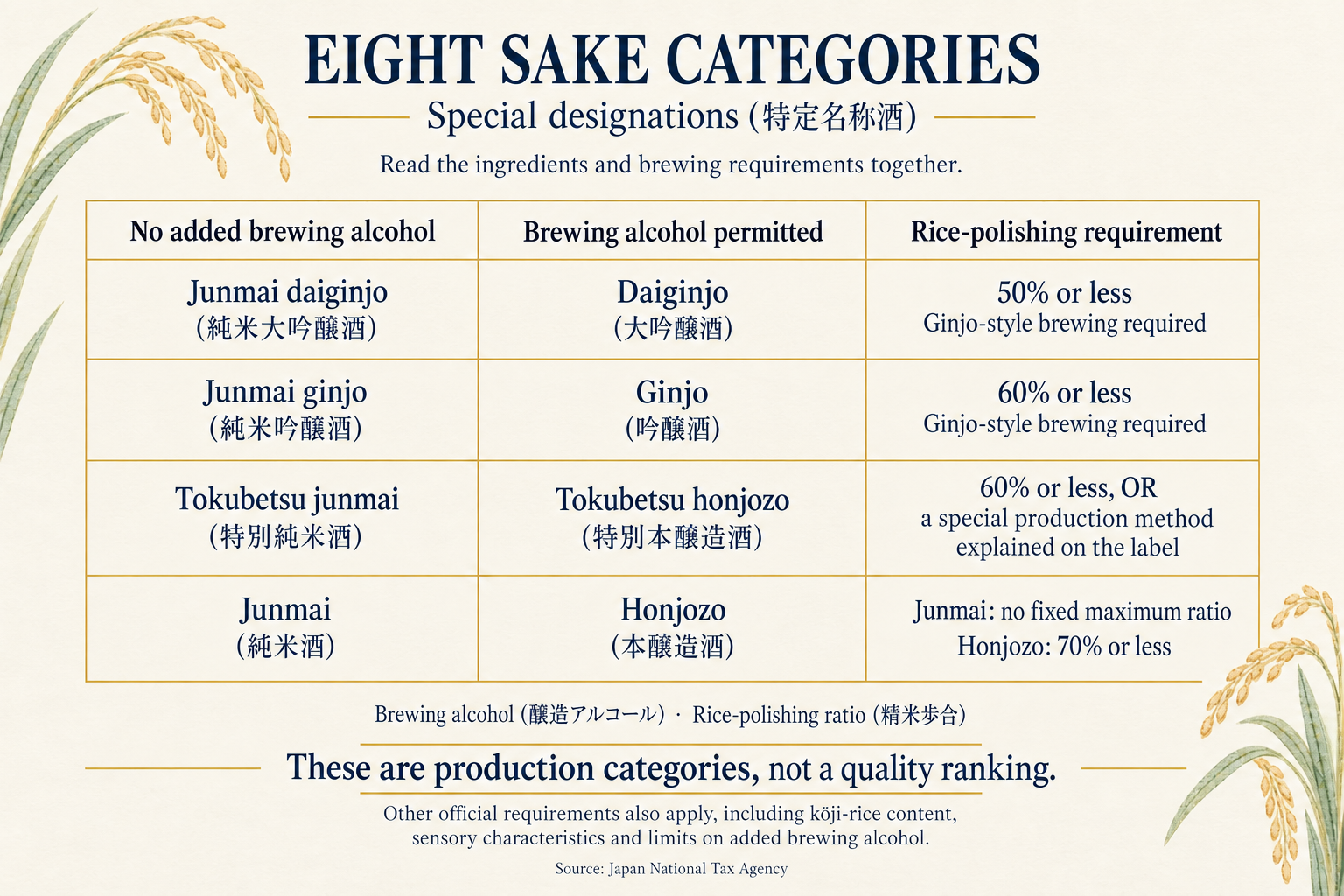
Read across each row to compare ingredients and production requirements. These designations describe how sake is made; they do not rank its quality. The table below provides a text version.
| Without added brewing alcohol | Brewing alcohol permitted | Main polishing requirement |
|---|---|---|
| Junmai daiginjo (純米大吟醸酒) | Daiginjo (大吟醸酒) | 50% or less; ginjo-style brewing and other conditions |
| Junmai ginjo (純米吟醸酒) | Ginjo (吟醸酒) | 60% or less; ginjo-style brewing and other conditions |
| Tokubetsu junmai (特別純米酒) | Tokubetsu honjozo (特別本醸造酒) | 60% or less, or a special production method explained on the label |
| Junmai (純米酒) | Honjozo (本醸造酒) | No uniform polishing ceiling for junmai; 70% or less for honjozo |
This is a reading guide. Requirements also cover kōji-rice proportions, sensory characteristics and, where applicable, limits on added brewing alcohol. Consult the full official standards for details. Sake outside these categories includes futsūshu (普通酒), often translated as ordinary sake; the absence of a special designation alone does not establish poor quality.
Coming next: Nada’s five brewing districts (灘五郷)—and the sea route to Edo. We move from the bottle to the place, tracing the relationship between water, brewing and a working port.
 Kindness & Honesty
Leave a comment